Do You Have to Remove All Your Teeth for All-on-4®?
One of the biggest concerns patients have when considering full arch dental implants is whether they will need to have all their remaining teeth removed. For someone who has spent years trying to preserve their natural smile, the thought of extraction can feel overwhelming, especially when some teeth still appear healthy.
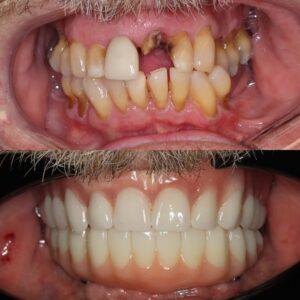
All-on-4® tooth removal is not automatically necessary for every patient. The treatment is designed to replace a complete arch of teeth, but whether your remaining natural teeth need to be extracted depends on their condition, long-term prognosis, and the overall restorative plan.
Some patients begin treatment after losing all their teeth. Others still have several teeth that are severely damaged, loose, infected, or no longer predictable to maintain.
The important distinction is that All-on-4® is not intended to replace healthy teeth simply because dental implants are available. A comprehensive examination should determine whether preserving your natural teeth or pursuing full arch replacement is the more appropriate option.
Understanding how that decision is made can help you feel more confident when discussing your treatment options.
What Is All-on-4® Designed to Replace?
All-on-4® is a dental implant treatment concept designed to support a complete arch of replacement teeth using four strategically positioned implants.
Rather than replacing each missing tooth with an individual implant, the implants support a connected full arch restoration.
This approach may be considered for patients who have already lost most or all their teeth or whose remaining teeth have a poor long-term prognosis.
The restoration is fixed in place and is designed to provide a stable alternative to conventional removable dentures.
However, treatment planning involves more than counting how many teeth are missing.
Your dental team must evaluate the health of your remaining teeth, gum tissue, jawbone, bite, and overall medical history before recommending a particular approach.
Does All-on-4® Require Every Tooth to Be Extracted?
All-on-4® tooth removal depends on which arch is being treated and whether natural teeth remain within that arch.
If you are receiving a complete upper arch restoration, any remaining upper teeth generally need to be addressed as part of the treatment plan. The same applies to the lower arch when it is being replaced.
However, this does not mean you automatically need to remove every tooth in your entire mouth.
For example, someone may need a full arch replacement on the upper jaw while retaining healthy natural teeth in the lower jaw.
In that situation, treatment may focus on the upper arch while preserving the lower teeth.
Your dentist will evaluate how the proposed restoration will function against the opposing teeth and whether additional dental care is necessary.
Why Would a Dentist Recommend Removing Remaining Teeth?
There are several reasons a dentist may recommend extractions before placing full arch dental implants.
Some patients have advanced periodontal disease that has damaged the bone and tissues supporting their natural teeth.
Others may have extensive decay, repeated infections, fractured teeth, or restorations that can no longer be predictably maintained.
In certain circumstances, a patient may have spent years undergoing individual dental procedures without achieving lasting stability.
When multiple teeth have a poor prognosis, replacing the affected arch may become a reasonable treatment consideration.
The decision should be based on a thorough examination and an honest discussion about the benefits, limitations, and alternatives.
Removing natural teeth is irreversible, which makes careful treatment planning especially important.
What if Some of Your Teeth Are Still Healthy?
Having a few healthy teeth does not automatically mean they should be extracted.
Natural teeth provide important benefits, and preserving them is generally preferable when doing so is clinically appropriate.
If you have several healthy teeth alongside others that need treatment, your dentist should evaluate whether those teeth can be maintained through a different restorative approach.
Depending on your circumstances, alternatives may include individual dental implants, bridges, periodontal treatment, or other restorative procedures.
A complete arch replacement is not the only solution for every patient with missing or damaged teeth.
The appropriate recommendation depends on your oral health, treatment goals, and the long-term outlook for the teeth you still have.
Can You Keep Your Front Teeth and Replace Only the Back Teeth?
If your front teeth are healthy and you are primarily missing molars or premolars, you may not need All-on-4®.
A full arch restoration is designed to replace an entire row of teeth rather than fill isolated spaces.
Patients who are missing only certain teeth may benefit from individual implants or other restorative options that preserve their remaining natural dentition.
However, the appearance of your front teeth does not always reveal their underlying condition.
Teeth can look relatively normal while experiencing significant periodontal damage, structural problems, or other concerns.
Your dental team will need to assess their actual health before determining whether they can be preserved.
How Dentists Determine Whether Teeth Can Be Saved
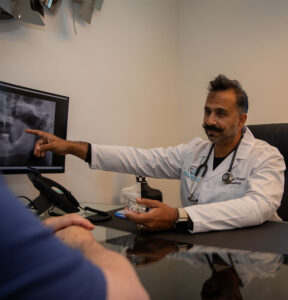
A comprehensive examination helps establish whether your remaining teeth have a reasonable long-term prognosis.
Your dentist may evaluate the amount of healthy tooth structure remaining, the condition of existing restorations, gum health, bone support, mobility, and signs of infection.
Dental imaging can provide additional information about areas that are not visible during a routine examination.
The evaluation should also consider your overall bite and whether the remaining teeth can function predictably after treatment.
Sometimes a tooth can technically be repaired but may still have a poor long-term outlook.
In other cases, a tooth that appears badly damaged may have a reasonable treatment option.
This is why decisions about extractions should be made individually rather than assuming that every compromised tooth must be removed.
All-on-4® Tooth Removal and Advanced Gum Disease
Advanced periodontal disease is one reason patients begin exploring full arch dental implants.
Periodontal disease affects the tissues and bone supporting natural teeth. When it progresses significantly, teeth may become loose or develop a poor prognosis.
If several teeth have lost substantial support, your dentist may discuss whether preserving them remains predictable.
However, removing affected teeth does not eliminate the importance of periodontal health.
Dental implants also depend on healthy surrounding tissues and require consistent maintenance.
Any active oral infection or inflammation must be evaluated and appropriately managed as part of your treatment plan.
What if You Have Repeated Dental Infections?
Recurring dental infections can make it difficult to maintain comfortable, functional teeth.
Some patients experience repeated abscesses, fractured restorations, or infections involving teeth that have already undergone extensive treatment.
When these problems affect multiple teeth, your dentist may need to evaluate whether additional individual procedures are likely to provide a predictable outcome.
This does not mean one infected tooth is automatically a reason to replace an entire arch.
An isolated problem may have a more conservative solution.
Full arch treatment becomes a consideration when the overall condition of the remaining teeth supports that approach.
Can Extractions and Implant Placement Happen on the Same Day?
In selected cases, remaining teeth can be extracted and dental implants placed during the same surgical appointment.
This approach may reduce the number of separate surgical visits required.
However, same-day implant placement is not appropriate for everyone.
Your dental team must consider factors such as available bone, infection, implant stability, medical history, and the overall surgical plan.
Some patients may require additional healing or a staged approach before implant placement.
The treatment sequence should be based on clinical findings rather than the expectation that every patient can follow the same timeline.
Will You Have to Go Without Teeth After Extractions?
One of the reasons patients explore All-on-4® is the possibility of receiving temporary fixed teeth shortly after implant placement.
For appropriately selected patients, a temporary full arch restoration may be attached during the early healing period.
This can allow patients to maintain the appearance of a complete smile while their implants integrate with the surrounding bone.
However, immediate temporary teeth depend on factors such as implant stability and the conditions observed during surgery.
Your dental team should explain whether this approach is suitable for you and what alternatives are available if a different healing plan is recommended.
Even when temporary teeth are placed immediately, patients must follow postoperative instructions and dietary restrictions to protect the healing implants.
Is Removing Multiple Teeth More Difficult Than Removing One?
The experience varies depending on the condition and location of the teeth, the complexity of the extractions, and the procedures being performed during the appointment.
Your dental team will review your medical history and discuss the anesthesia or sedation options appropriate for your circumstances.
Some patients are primarily concerned about discomfort, while others worry about swelling, recovery time, or returning to their normal routine.
These are all reasonable questions to discuss before treatment.
Your dentist should provide individualized postoperative instructions and explain what symptoms to expect during recovery.
What if You Are Emotionally Attached to Your Natural Teeth?
For many people, the decision to remove their remaining teeth is not purely clinical.
Even when teeth are severely compromised, they are still part of your identity. You may have spent years trying to preserve them through fillings, crowns, root canals, or periodontal treatment.
It is understandable to feel hesitant about making an irreversible decision.
A good consultation should give you room to ask questions and understand why a particular recommendation is being made.
If you are unsure whether your remaining teeth truly need to be extracted, ask your dentist to explain their prognosis and discuss reasonable alternatives.
You should understand the treatment plan before agreeing to proceed.
What Questions Should You Ask Before Agreeing to Extractions?
Before moving forward with full arch treatment, make sure you understand why your dentist is recommending the removal of your remaining teeth.
Useful questions include:
- Which teeth have a poor long-term prognosis, and why?
- Are any of my remaining teeth healthy enough to preserve?
- What alternatives are available if I do not want a complete arch replacement?
- Will extractions and implant placement happen during the same appointment?
- Am I a candidate for temporary fixed teeth?
- What should I expect during healing and recovery?
These questions can help you make an informed decision based on your actual dental condition rather than assumptions about how All-on-4® works.
Is All-on-4® Always the Best Choice for Failing Teeth?
No single treatment is appropriate for every patient.
All-on-4® can be an option for people who have lost an entire arch of teeth or whose remaining teeth cannot be predictably maintained.
However, patients with healthy or restorable teeth may benefit from other treatment approaches.
Your dentist should consider the condition of your natural teeth, the available bone, your medical history, and your personal goals before recommending full arch replacement.
The objective is not simply to provide dental implants. It is to develop a treatment plan that supports your long-term oral health and function.
Do You Have to Remove All Your Teeth for All-on-4®?
All-on-4® tooth removal is determined by the condition of the teeth within the arch being replaced. Patients who already have no teeth in that arch do not require extractions, while those with remaining teeth may need them removed as part of a complete arch replacement.
However, healthy teeth in an opposing arch do not automatically need to be extracted, and patients with only a few missing or damaged teeth may have more conservative options available.
At Full Arch Dental Implant Center in Lake Havasu City, we believe patients should understand why a treatment is being recommended before making an irreversible decision. A comprehensive consultation can help determine whether your remaining teeth can be preserved or whether All-on-4® may be an appropriate solution.
The goal is to find the right treatment for your individual dental needs, not to remove teeth that could otherwise be predictably maintained.