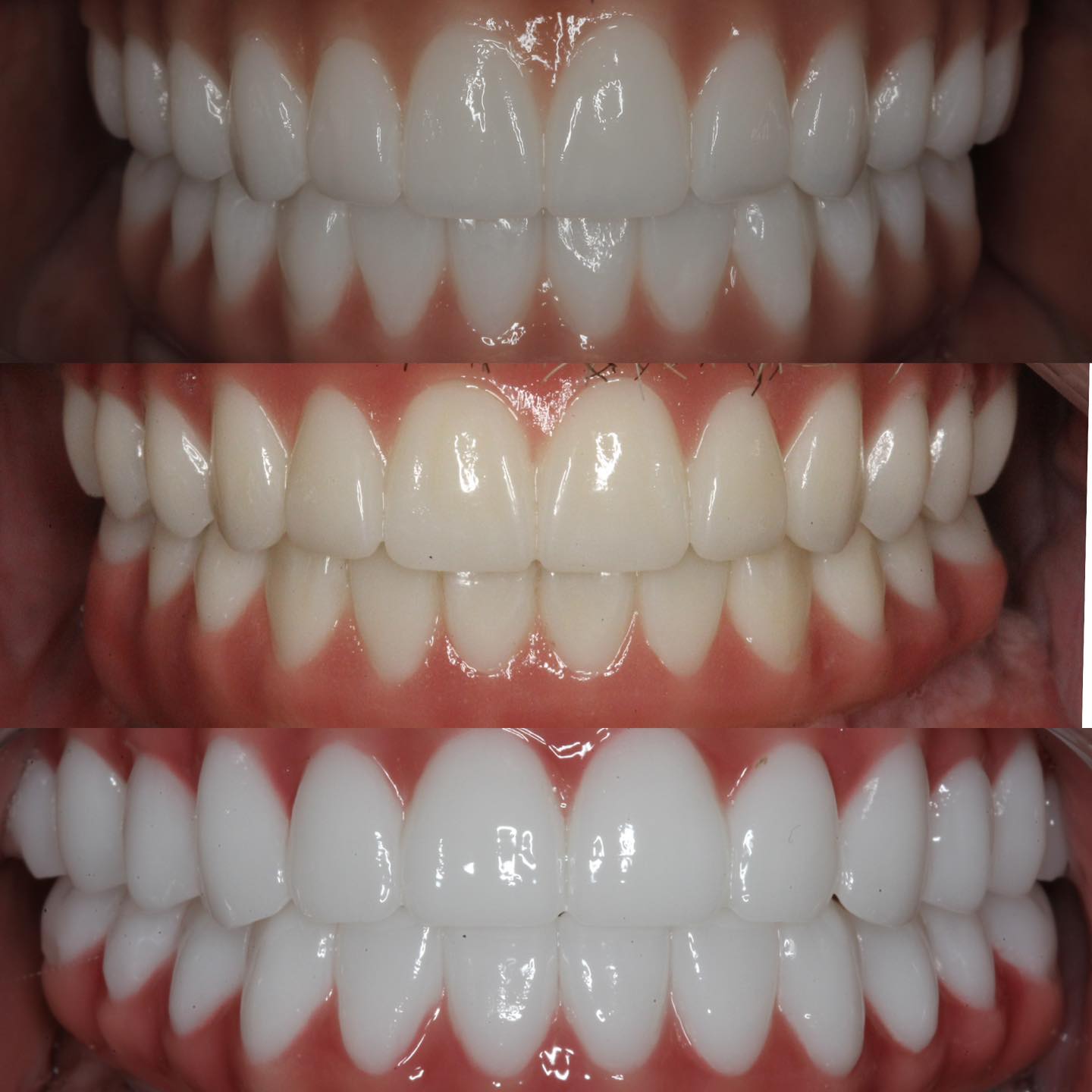
Can All-on-4® teeth stain even though they are not natural teeth? It is a reasonable question, especially for patients who drink coffee every morning, enjoy tea or red wine, smoke, or have spent years dealing with discoloration in their natural teeth.
All-on-4® replacement teeth are made from dental materials rather than natural enamel, so they behave differently. They cannot develop cavities or internal tooth discoloration in the same way natural teeth can. However, that does not mean the appearance of your restoration can never change.
The material used for your restoration, your habits, your cleaning routine, and how long you have had your teeth can all affect how your smile looks over time.
What Are All-on-4® Teeth Made From?
There is not one universal material used for every All-on-4® restoration. The material used for temporary teeth may also be different from the material selected for a patient’s final restoration.
Depending on the treatment plan, full arch restorations can be made from materials such as acrylic, composite, zirconia, or combinations of dental materials.
Those materials have different characteristics.
Some are more resistant to staining than others. Some may be more susceptible to surface changes or wear over time. This is one reason you should ask your dental team exactly what your restoration is made from and how they recommend caring for it.
Advice that applies to one type of dental restoration may not be appropriate for another.
Can All-on-4® Teeth Stain From Coffee?
Coffee is probably one of the first things patients think about when discussing stains.
Natural teeth can gradually become discolored from frequent exposure to coffee because pigments can contribute to surface staining.
All-on-4® restorations respond differently depending on their material and surface condition. Highly polished dental materials may resist staining better than natural enamel or certain other restorative materials, but surface discoloration can still become a concern in some situations.
This does not necessarily mean you have to give up coffee forever.
Once you are fully recovered and cleared to return to your normal diet, good oral hygiene can help maintain the appearance of your restoration.
Rinsing with water after coffee can also help remove some residue from the mouth.
During the immediate postoperative period, however, follow your dental team’s instructions about coffee and other beverages rather than focusing on staining.
What About Tea and Red Wine?
Darkly pigmented beverages can contribute to surface staining of dental materials over time.
Tea, red wine, coffee, and similar drinks are common examples.
How noticeable that becomes depends partly on the material used for your teeth and how well the restoration is maintained.
Frequency matters too.
Something you drink several times every day has much more contact with your restoration than something you have occasionally.
You do not necessarily need to become afraid of anything with color in it. Your goal is simply to understand that artificial teeth still benefit from being kept clean.
Does Smoking Stain All-on-4® Teeth?
Smoking creates concerns that go well beyond the appearance of the teeth.
Tobacco products can contribute to staining and discoloration, but smoking is also an important risk factor when discussing oral health and dental implants.
Your implants depend on healthy gum tissue and supporting bone.
If you smoke, be honest with your implant dentist. Your dental team needs accurate information about your habits so they can properly evaluate your oral health and implant risk factors.
If the only thing preventing you from worrying about smoking is the idea that your artificial teeth cannot stain, you are overlooking the more important issue.
The health of the tissues supporting your implants matters much more than the shade of the restoration.
Can Food Stain All-on-4® Teeth?
Certain foods contain strong pigments that can contribute to surface discoloration of teeth and dental restorations.
Tomato sauces, berries, curry, dark sauces, and other strongly colored foods are common examples patients ask about.
Again, this does not mean you need to eliminate colorful foods from your diet once you have fully healed.
Regular cleaning is much more realistic than attempting to eat an entirely colorless diet.
Brush according to your dental team’s recommendations and clean underneath the restoration as instructed.
If you notice surface discoloration that does not improve with your normal routine, ask about it at your maintenance appointment rather than experimenting with aggressive cleaning methods at home.
Can You Whiten All-on-4® Teeth?
This is where an important difference between natural teeth and replacement teeth becomes obvious.
Traditional tooth whitening products are designed to change the color of natural tooth structure. They do not necessarily whiten dental restorations in the same way.
If you decide that you want your All-on-4® teeth to be lighter several years after treatment, buying a box of whitening strips may not produce the result you expect.
Do not repeatedly apply whitening products in an attempt to force the restoration to change color.
Ask your dental team first.
They can determine whether what you are seeing is surface staining that may respond to professional cleaning or polishing, or whether the color is inherent to the restorative material.
This is also one reason shade selection is important when your restoration is being designed.
Can Whitening Toothpaste Remove Stains?
Be cautious with abrasive products.
A toothpaste advertised as extremely powerful against stains may sound perfect, but aggressive abrasives are not automatically appropriate for every dental restoration.
Scratching or roughening the surface of a restoration could potentially make it easier for plaque or stains to accumulate in the future.
Use products recommended for your particular restoration.
Your dentist or hygienist can tell you what type of toothpaste is appropriate.
The goal is to clean the restoration without unnecessarily damaging its surface.
The same principle applies to homemade whitening tricks.
Avoid scrubbing your All-on-4® teeth with harsh substances because you saw someone doing it in a social media video.
Your restoration is an investment. Treat it like one.
What if One Tooth Looks Different From the Others?
A noticeable color change in one area deserves attention.
Sometimes what appears to be discoloration may actually be surface buildup.
In other situations, there could be a change involving the restorative material itself.
Do not immediately assume the entire restoration needs to be replaced.
Schedule an evaluation.
Your dental team can clean the area and examine the restoration to determine what you are actually seeing.
Photos can also be useful if you notice that the appearance seems to be changing over time.
Professional Cleaning Helps Maintain the Appearance
Maintenance appointments are not only about making your teeth look clean.
Your dental team is also evaluating the implants, gum tissue, bite, and restoration.
However, professional cleaning can help remove deposits and surface buildup that your normal toothbrush may not completely address.
This is particularly important underneath a full arch restoration.
Even if the visible teeth look beautiful, plaque and food debris can accumulate in less visible areas.
A good maintenance routine protects both appearance and health.
That is why skipping dental visits simply because artificial teeth cannot develop cavities is a mistake.
Will All-on-4® Teeth Stay the Exact Same Shade Forever?
Dental restorations are designed for durability, but your mouth is a demanding environment.
Your teeth are exposed to food, beverages, temperature changes, chewing forces, bacteria, cleaning products, and thousands of daily contacts.
Over many years, restorative materials can experience wear and surface changes.
How noticeable those changes become varies.
Someone who smokes heavily and drinks several cups of coffee every day may have a different experience from someone with different habits.
The material used for the restoration also makes a difference.
Rather than expecting your restoration to remain completely untouched by time, think in terms of maintenance.
The better question is: How can I keep my All-on-4® teeth looking their best for as long as possible?
Daily Habits Make a Difference
Maintaining the appearance of your new smile does not need to become complicated.
Brush your restoration consistently using the products your dental team recommends. Clean underneath it. Keep your professional maintenance appointments. Drink plenty of water and rinse your mouth when appropriate after consuming strongly pigmented foods or beverages.
Avoid tobacco.
Do not use abrasive homemade cleaning methods.
And if something changes, ask about it.
These habits also help protect something much more important than the color of your teeth: the health of the tissues supporting your implants.
Choosing the Shade of Your Final Teeth
If you are still in the treatment process, talk openly about tooth color before your final restoration is completed.
Some patients want an extremely bright smile.
Others prefer a more natural shade.
Neither preference is automatically right or wrong.
The goal is to create a result that works with your smile, facial features, and personal preferences while maintaining appropriate function.
This is the time to communicate.
Once restorative materials are fabricated, changing their shade is not as simple as whitening natural teeth later.
If you have a strong preference about color, make sure your dental team knows before the final restoration is completed.
Can All-on-4® Teeth Stain or Change Color?
All-on-4® teeth can experience surface staining or changes in appearance depending on the material used, your habits, and how the restoration is maintained. However, they do not discolor in exactly the same way as natural tooth enamel.
Coffee, tea, tobacco, strongly pigmented foods, plaque buildup, and years of everyday use can all influence how a restoration looks.
The answer is not aggressive whitening or scrubbing.
It is proper maintenance.
At Full Arch Dental Implant Center in Lake Havasu City, we want patients to enjoy their new smile while also understanding how to protect it. Knowing which products to use, keeping the restoration clean, and maintaining regular professional visits can help your All-on-4® teeth continue looking their best long after your treatment is complete.
Why Do Some Patients Need More Than Four Dental Implants?
Why Do Some Patients Need More Than Four Dental Implants? If you have been researching full arch dental implants, you