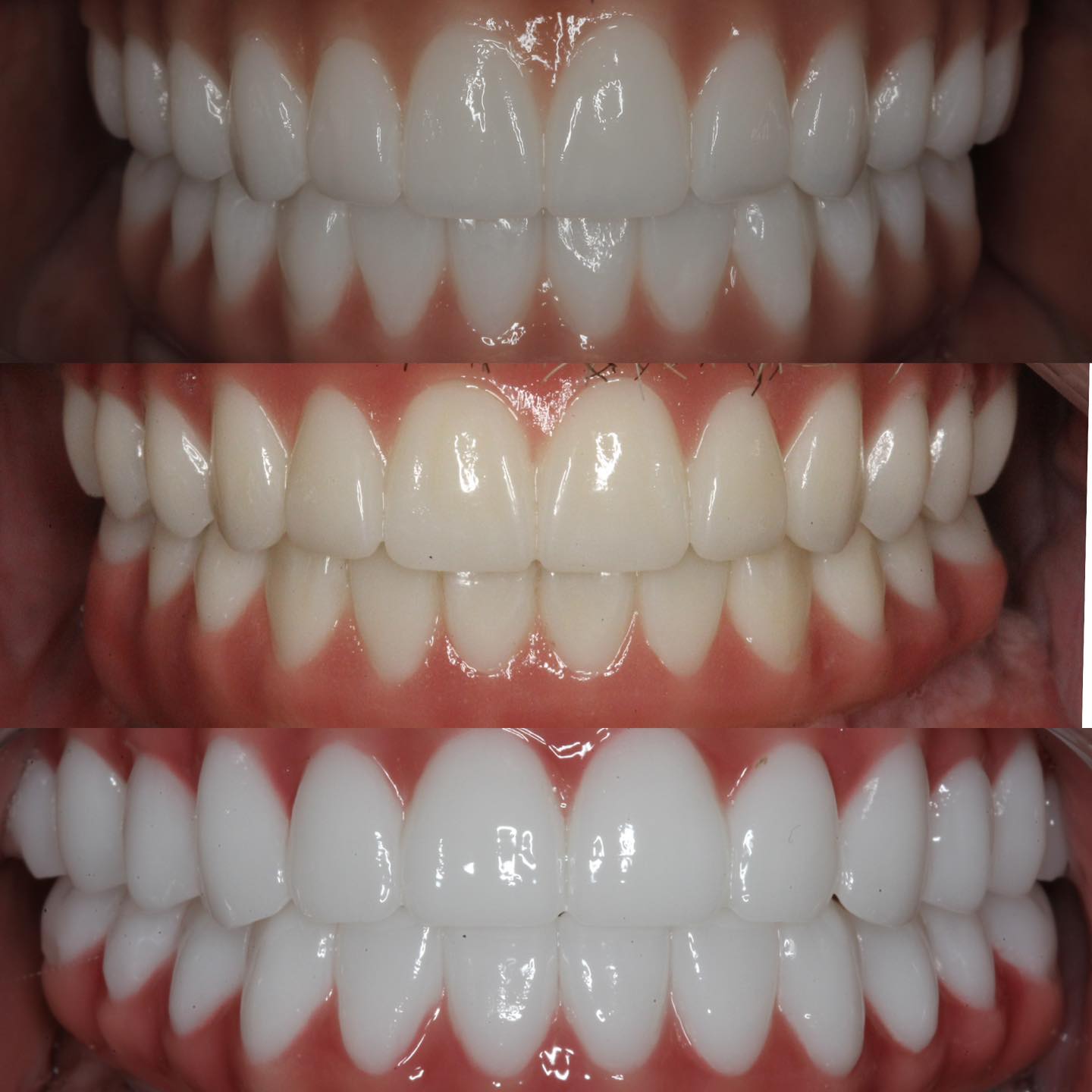
Understanding the difference between temporary and final All-on-4® teeth can make the treatment process much less confusing. One of the most exciting parts of All-on-4® treatment is that many patients can receive a fixed set of teeth around the time their implants are placed. But those first teeth are not necessarily the restoration you will have for the rest of your life.
They are often temporary teeth designed to carry you through an important healing period.
That surprises some patients. They see a complete smile in the mirror, the teeth are attached, and everything looks finished. From the outside, it may feel like treatment is already over.
Underneath those teeth, however, your mouth is still healing.
Your temporary restoration gives you teeth during that process while your implants and surrounding tissues move toward the stage when your final restoration can be made.
Why Are Temporary All-on-4® Teeth Used?
Temporary All-on-4® teeth serve an important purpose.
After dental implants are placed, they need time to heal within the jawbone. During this period, a biological process called osseointegration takes place as bone develops a stable connection around the implant surfaces.
You cannot see this happening.
Your smile may already look dramatically different while the foundation underneath it is still developing.
Temporary teeth allow you to have a fixed restoration during this period rather than waiting for the entire healing process to finish before receiving teeth.
They also give your dental team an opportunity to observe how your mouth responds to the new restoration.
Your bite, speech, comfort, appearance, and ability to clean around the restoration can all provide useful information.
Why Not Give You the Final Teeth Immediately?
It is easy to assume that the final restoration should simply be made before surgery and installed immediately.
The problem is that your mouth can change during healing.
If teeth were extracted, the surrounding tissues may change as those areas heal. Swelling decreases. Gum contours can change. Your bite and muscles begin adapting to the new teeth.
Making a definitive restoration before those changes have occurred may not provide the same opportunity to account for how your mouth actually heals.
The temporary stage gives the treatment process room to evolve.
This does not mean the temporary teeth are an afterthought.
They are part of the treatment plan.
Temporary Does Not Mean Removable
The word “temporary” can create confusion because patients often associate temporary dental work with something loose or removable.
Temporary All-on-4® teeth may still be fixed to the implant system.
You should not be taking them in and out at home.
They can look and feel dramatically different from removable dentures because they are supported by dental implants rather than relying solely on the gums.
The word temporary refers to their role in the treatment timeline, not necessarily to whether you can remove them yourself.
Your dental team should explain exactly what type of restoration you have and how you are expected to care for it.
Why Do Temporary All-on-4® Teeth Need to Be Protected?
This is one of the most important parts of the temporary stage.
Your teeth may feel strong before the implants underneath them have completed healing.
That can create false confidence.
You bite into something soft and everything feels solid. A few days later, you begin wondering why you cannot have steak, nuts, crunchy bread, or other foods.
The dietary restrictions are not simply about whether the temporary teeth can physically chew the food.
Your dental team is also trying to control the forces transferred to the healing implants.
The early healing period is not the time to test how powerful your new bite can be.
Follow your soft food instructions even when your mouth feels surprisingly good.
Do Temporary Teeth Look Different From Final Teeth?
They can.
Your temporary teeth are designed to give you function and appearance during healing, but the final restoration represents a later stage of treatment.
During the temporary period, your dental team can gather information about how the teeth look and function in your actual mouth.
Maybe you love the tooth size.
Maybe you want to discuss the appearance of the smile.
Perhaps your speech feels different.
Maybe the bite needs refinement.
These are useful conversations.
Do not assume you have to silently accept something that concerns you because you think the treatment is already finished.
Tell your dental team what you notice.
What Can Your Dentist Learn From the Temporary Teeth?
Quite a lot.
A picture or digital design can provide valuable information before treatment, but actually living with teeth provides a different perspective.
You use them to speak.
You smile naturally.
You see yourself in different lighting.
You interact with friends and family.
You discover where your tongue rests.
You learn how the teeth feel when you close your mouth.
Your dentist can also evaluate your bite and how the restoration functions over time.
That experience can help guide decisions during the treatment process.
Your Temporary Teeth May Feel Strange at First
Receiving an entire arch of teeth is a major change.
Your tongue may constantly touch them.
Certain words may sound unusual.
The teeth may initially feel large simply because your mouth is not accustomed to them.
Your bite may feel unfamiliar.
Some of this can improve as swelling decreases and your brain adapts.
Do not judge the entire outcome of treatment based on how your mouth feels during the first few days.
At the same time, communicate persistent concerns.
There is a difference between allowing yourself time to adapt and ignoring a problem that should be evaluated.
What Happens if Temporary All-on-4® Teeth Break?
Temporary teeth still need to be cared for.
If you notice a crack, chip, movement, or other damage, contact your dental team.
Do not use household glue.
Do not attempt to repair the restoration yourself.
And do not continue chewing hard foods on an area that feels damaged simply because it does not hurt.
Your dental team needs to determine what has happened.
Sometimes the issue may involve the restoration itself rather than the implants, but only an examination can determine that.
Following dietary instructions can help reduce unnecessary stress during this stage.
When Do You Receive the Final All-on-4® Teeth?
The timing varies because healing is individual.
Your dental team needs to determine when your mouth and implants are ready to move forward.
This decision should not be based only on the calendar.
Your dentist may consider your healing progress, implant stability, tissues, bite, and other aspects of treatment before proceeding.
Someone else’s timeline does not automatically apply to you.
If another patient says they received their final teeth at a certain point, that does not mean your treatment should follow the exact same schedule.
The goal is not to race to the final restoration.
The goal is to reach that stage appropriately.
What Makes the Final Restoration Different?
Your final All-on-4® teeth are designed as the definitive restoration for your healed treatment.
By this point, your dental team has had the opportunity to see how you adapted to the temporary teeth and how your mouth healed.
The final restoration can be planned using the information gathered throughout that process.
Material choices and design can vary depending on the treatment plan and implant system.
Your dentist should explain what your final restoration will be made from and why that material was selected for you.
Rather than focusing only on whether one material is considered “best,” look at the entire design.
Strength, appearance, bite, cleansability, available space, and your individual needs all matter.
Will Final All-on-4® Teeth Feel More Natural?
Many patients become increasingly comfortable with their teeth as they adapt.
By the time you reach the final stage, you may already be much more accustomed to having a fixed full arch restoration than you were immediately after surgery.
The final teeth should be designed with long-term function in mind, but remember that artificial teeth do not become biological natural teeth.
The sensation can still be different.
You no longer have the periodontal ligament surrounding a natural tooth root in the same way you did with your original teeth.
Your brain learns to interpret your new bite through the information available from the implants, muscles, jaw joints, and surrounding tissues.
Over time, the restoration can begin to feel increasingly normal simply because it becomes part of your everyday life.
Do Final Teeth Mean You Can Eat Anything?
Receiving your final restoration is an exciting milestone, but it does not make your teeth indestructible.
Once your dental team has cleared you for a broader diet, you may be able to enjoy foods that were restricted during healing.
That does not mean you should intentionally challenge the restoration with extremely hard objects.
Natural teeth can break.
Artificial teeth can also chip, wear, or become damaged.
Do not chew ice.
Do not use your teeth to open packaging.
Do not crack shells or other objects with them.
The goal is normal function, not proving how much force the restoration can withstand.
Cleaning Still Matters With Both Temporary and Final Teeth
Neither temporary nor final All-on-4® teeth eliminate the need for oral hygiene.
The artificial teeth themselves cannot develop cavities like natural enamel, but the tissues around your implants still require care.
Plaque and food debris can accumulate around and underneath the restoration.
Your cleaning routine may change as you progress through treatment.
Early after surgery, your dental team may provide very specific instructions to avoid disturbing healing tissues.
Later, you may be taught additional methods for cleaning underneath your full arch restoration.
Follow the instructions for your current stage rather than assuming one cleaning routine applies from the first day onward.
Final Teeth Are Not the End of Dental Care
It is tempting to think of receiving your final All-on-4® teeth as graduation from the dentist.
You are finished with failing teeth, so why would you need to keep coming back?
Because the implants, gums, supporting bone, bite, restorative components, and final teeth still need long-term monitoring.
Maintenance appointments allow your dental team to look for changes before they become obvious to you.
Your restoration may also require professional maintenance over the years.
Think of receiving the final teeth as the beginning of the long-term maintenance phase, not the end of dental care.
What Is the Difference Between Temporary and Final All-on-4® Teeth?
Temporary and final All-on-4® teeth serve different purposes within the same treatment.
Temporary teeth allow you to have a fixed smile while your implants and tissues heal. They also give you and your dental team time to learn how the new teeth function, feel, look, and affect your bite and speech.
The final restoration comes later, after your mouth has had time to heal and your dental team has gathered information from the temporary stage.
At Full Arch Dental Implant Center in Lake Havasu City, we want patients to understand that the time between surgery and final teeth is not simply a waiting period. It is an important part of the All-on-4® process. Protecting your temporary teeth, following your diet, attending follow-up visits, and communicating what you experience can all help your dental team guide you toward the final stage of your new smile.
Why Do Some Patients Need More Than Four Dental Implants?
Why Do Some Patients Need More Than Four Dental Implants? If you have been researching full arch dental implants, you