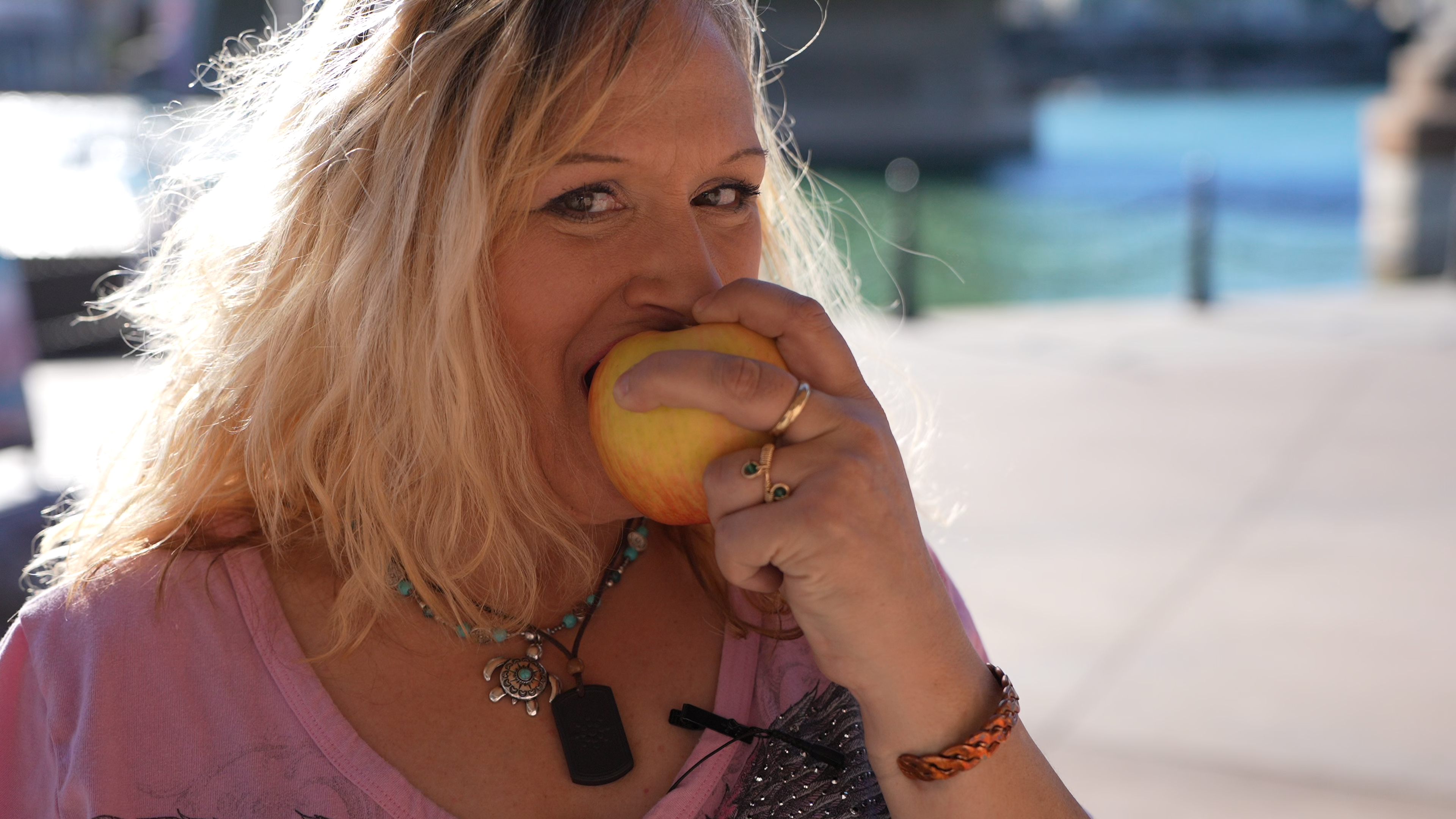
Being able to bite into an apple with All-on-4® dental implants might sound like a strangely specific goal, but it represents something much bigger for many patients. People who have lived with loose dentures, missing teeth, painful teeth, or severe dental problems often spend years modifying the way they eat.
They cut everything into tiny pieces. They avoid biting with their front teeth. They chew exclusively on one side. Some stop eating certain foods altogether because they are worried a tooth will break or a denture will move.
After receiving All-on-4®, it is natural to wonder when those restrictions can finally disappear.
An apple is actually a good example because biting directly into one requires considerably more force than eating applesauce or small pieces of peeled apple.
Whether you should do it depends heavily on where you are in the healing process.
Immediately After Surgery? Probably Not
The first thing to understand is that having fixed teeth immediately after All-on-4® surgery does not mean your implants are fully healed.
Your restoration may feel surprisingly stable.
That stability can be deceptive.
Underneath your new teeth, the dental implants are beginning the process of integrating with your jawbone. That biological healing takes time.
During this stage, your dental team will usually provide specific dietary restrictions designed to limit excessive pressure on the implants.
Biting directly into a crisp apple would generally not fit the definition of a soft diet.
Even if you feel capable of doing it, follow the diet your dentist prescribed.
Why Is an Apple So Challenging?
Apples are not extremely hard compared with something like ice or hard candy, but biting directly through the skin and flesh requires your front teeth to apply force.
The shape also matters.
When you bite into a whole apple, you are asking a relatively small section of your restoration to handle the initial pressure.
Compare that with eating a soft food that can easily be compressed with minimal chewing.
The difference in force can be significant.
Once your implants are healed and your dentist has cleared you for a broader diet, those forces may be much more appropriate.
During early healing, however, there is no benefit to testing the limits.
Your Teeth Can Feel Healed Before Your Implants Are Healed
This is one of the most important ideas for All-on-4® patients to understand.
Pain is not a reliable measurement of implant healing.
Your swelling can disappear.
Your gums can stop feeling tender.
You can return to work.
Your speech can improve.
Your new teeth can start feeling like they belong in your mouth.
Meanwhile, the bone around your implants is still healing.
This is why patients can become overconfident a few weeks into recovery.
They feel great, so they assume all restrictions are over.
Your dentist’s timeline should determine when you advance your diet, not the absence of discomfort.
What Is Osseointegration?
Osseointegration describes the process through which bone develops a stable connection with the surface of a dental implant.
This is essential to long-term implant stability.
It occurs beneath the gums, so you cannot watch it happen.
You also cannot accurately judge it by pressing on your restoration or biting down.
Your dental team monitors your progress and determines when your implants are ready for greater functional demands.
This is why postoperative appointments matter.
Healing is happening even when there is nothing dramatic for you to see.
Can You Cut an Apple Into Small Pieces?
During certain stages of recovery, your dental team may eventually allow foods that are somewhat firmer as long as they are prepared in a way that reduces chewing force.
That does not mean you should automatically start eating apple slices without asking.
However, cutting foods into smaller pieces can reduce the amount of force required compared with biting directly into a whole food.
Your dentist may gradually expand your diet as healing progresses.
Ask what textures are appropriate at your particular stage.
The difference between “I can eat this food” and “I can bite directly into this food” can matter.
What About the Final All-on-4® Teeth?
Once healing is complete and your dentist has cleared you for normal function, All-on-4® is intended to provide meaningful chewing ability.
For many patients, returning to foods they previously avoided is one of the most exciting parts of treatment.
That does not mean your final restoration is indestructible.
Dental restorations can chip, wear, or become damaged just like other materials subjected to years of repeated force.
Even people with completely natural teeth are advised not to use them as tools or deliberately chew extremely hard objects.
There is a difference between using your teeth normally and trying to prove how strong they are.
Can Biting an Apple Break All-on-4® Teeth?
A properly designed final restoration is intended to handle normal everyday function, but no dentist can promise that a dental restoration will never chip or break.
Several factors influence the risk of damage, including the material used for the restoration, your bite, whether you grind your teeth, the condition of the restoration, and exactly what you bite.
If your dentist has cleared you for normal eating, an ordinary food should not be treated the same way as chewing ice or biting nonfood objects.
However, if you feel nervous about biting directly into hard or crisp foods, there is nothing wrong with cutting them into pieces.
You do not receive extra points for eating an apple whole.
Can the Implants Break From Chewing?
Dental implants are designed to withstand substantial functional forces once appropriately healed and restored.
However, the implant is only one part of the entire system.
There is the implant in the bone, the components connecting the restoration, the restoration itself, the supporting tissues, and your bite.
This is why dentists look at the entire system during maintenance appointments.
If you grind your teeth heavily or place excessive force on the restoration, your dental team may recommend additional protection.
For some patients, that may include a night guard specifically designed for their new restoration.
Do not use an old appliance from before your All-on-4® treatment unless your dentist specifically tells you it is appropriate.
What if You Accidentally Bite Something Hard?
Accidents happen.
You may bite down on a popcorn kernel.
A food may contain a bone you did not notice.
Something that looked soft may be much harder than expected.
Do not immediately assume you destroyed your implants.
Pay attention to whether anything changed.
If you experience sudden pain, hear or feel a crack, notice a chipped area, feel movement, or notice that your bite suddenly feels different, contact your dental team.
Avoid repeatedly biting down to test the area.
If you suspect something happened, let your dentist examine it.
Why the Front Teeth Deserve Some Thought
People naturally associate strong teeth with being able to bite directly into foods.
Corn on the cob, sandwiches, apples, carrots, and crusty bread all involve the front teeth.
But your front teeth and back teeth perform different jobs.
Front teeth are primarily involved in biting and tearing, while the back teeth handle much of the grinding and chewing.
With a full arch restoration, your dentist carefully considers how forces are distributed across your bite.
That is another reason the design and adjustment of your All-on-4® restoration matter.
If biting with the front teeth consistently feels uncomfortable even after you have healed, mention it to your dentist rather than simply avoiding the area forever.
Eating Normally Is About More Than Apples
Patients rarely seek full arch dental implants because they desperately want to eat one specific food.
They want freedom.
They want to order something at a restaurant without first wondering whether their teeth can handle it.
They want to attend a family dinner without worrying about a denture moving.
They want to eat with friends without pain.
They want to stop examining every menu through the lens of their dental problems.
That is the larger goal of restoring chewing function.
It takes patience to get there.
The early healing diet may feel restrictive precisely because you finally have teeth that look and feel stronger.
But those restrictions are temporary and serve an important purpose.
When Can You Start Trying Harder Foods?
Your dental team should tell you when you can transition from a soft diet toward more normal foods.
This decision can depend on your healing, implant stability, procedures performed, restoration, bone condition, and other individual factors.
Do not pick a specific number of weeks from an online article and treat it as permission.
Your dentist has actually examined your mouth.
Use their guidance.
When you are cleared to expand your diet, you can do it gradually.
You do not need to celebrate the end of your soft diet with the toughest steak in Arizona.
Start reasonably and pay attention to how your mouth responds.
Long-Term Common Sense Still Matters
After healing, your All-on-4® teeth should become part of your everyday life rather than something you are constantly afraid to use.
At the same time, protecting a major dental investment requires some common sense.
Do not chew ice.
Do not use your teeth to open packaging.
Do not bite pens, bottle caps, or other objects.
If a particular food is extremely hard, cutting it into smaller pieces is perfectly reasonable.
And if you grind your teeth, use whatever protective appliance your dentist recommends.
The goal is not to baby your restoration forever.
It is to use it normally without abusing it.
Can You Bite Into an Apple With All-on-4® Dental Implants?
Whether you can bite into an apple with All-on-4® dental implants depends largely on your stage of healing. During early recovery, a whole crisp apple is generally inconsistent with the soft diet used to protect healing implants.
Once your implants have healed and your dental team has cleared you for normal eating, your dietary options can expand significantly. Your dentist can tell you whether there are any specific restrictions based on your restoration and bite.
At Full Arch Dental Implant Center in Lake Havasu City, the goal of All-on-4® treatment is not simply to give patients teeth that look good in photographs. Restoring comfortable, useful function matters too. Following the recovery diet now helps protect the foundation that can allow you to enjoy a much wider range of foods later.
Why Do Some Patients Need More Than Four Dental Implants?
Why Do Some Patients Need More Than Four Dental Implants? If you have been researching full arch dental implants, you