
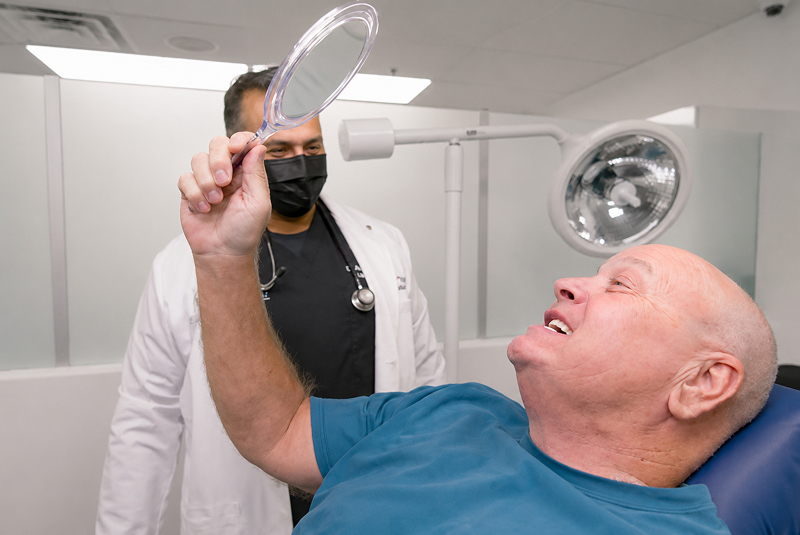
One of the biggest advantages of full arch dental implants is the ability to replace missing or failing teeth with a fixed restoration. For patients who have struggled with loose dentures, broken teeth, or difficulty chewing, the change can be significant.
However, receiving a new set of teeth does not mean those teeth are completely protected from damage.
Some patients grind or clench their teeth while sleeping, often without realizing it. These habits can place considerable pressure on natural teeth and dental restorations alike.
That raises an important question: can you wear an All-on-4® night guard to protect your new teeth?
In many cases, a professionally designed night guard may be recommended for patients with a history of grinding or clenching. However, not every patient needs one, and the appropriate appliance depends on the restoration, bite, and individual risk factors.
Understanding how nighttime grinding affects dental implants can help you protect your investment and maintain your restoration over time.
What Is a Night Guard?
A night guard is a removable dental appliance designed to fit over the teeth while a person sleeps.
It is commonly used for patients who grind or clench their teeth, a condition known as bruxism.
Night guards are made from different materials and can vary in thickness, rigidity, and design.
A professionally fabricated appliance is created to fit the patient’s mouth and accommodate their specific bite.
Depending on the clinical situation, a night guard may help protect tooth surfaces or restorative materials from excessive wear and distribute certain biting forces.
However, night guards do not necessarily stop the underlying habit of grinding or clenching.
Some patients continue producing substantial muscle forces while wearing an appliance.
The purpose is generally to help manage the effects of those forces rather than guarantee that grinding will disappear.
Why Do People Grind Their Teeth at Night?
Teeth grinding can occur for several reasons, and its causes are not always straightforward.
Sleep bruxism involves repetitive activity of the jaw muscles during sleep.
Some patients experience grinding, while others primarily clench their teeth together.
Stress may be associated with bruxism in certain individuals, but sleep bruxism can also be influenced by other factors.
Sleep disorders, medications, and individual neurological or physiological characteristics may contribute.
Many people do not realize they grind their teeth until a dentist notices unusual wear or a family member hears grinding sounds during the night.
Others become aware of the problem because they wake up with jaw soreness or headaches.
If you have a history of bruxism, it is important to discuss it before receiving full arch dental implants.
All-on-4® Night Guard: Why Might You Need One?
An All-on-4® night guard may be recommended when a dentist identifies a risk of excessive nighttime forces affecting the restoration.
All-on-4® uses strategically positioned dental implants to support a fixed arch of replacement teeth.
The restoration is designed to withstand normal functional forces associated with chewing and speaking.
However, nighttime grinding and clenching can create forces that differ from ordinary chewing.
These forces may be repeated over extended periods and can place additional demands on the restorative materials.
For some patients, a night guard may help reduce certain mechanical stresses or protect the surfaces of the replacement teeth.
The recommendation should be based on your bite, restoration design, and history of grinding rather than assuming every implant patient requires the same appliance.
Can Grinding Damage All-on-4® Teeth?
Yes. Excessive grinding or clenching can contribute to mechanical complications involving dental restorations.
Depending on the materials used, replacement teeth may experience wear, chipping, or fractures.
Other restorative components can also be affected by repeated forces.
However, grinding does not automatically mean your implants will fail.
Dental implant outcomes depend on several factors, including bone support, implant positioning, restoration design, oral hygiene, and overall health.
Your dentist must consider how your bite functions and whether there are signs of excessive stress.
A night guard may be one part of a broader plan to protect the restoration.
Will Dental Implants Stop You From Grinding Your Teeth?
Replacing natural teeth with dental implants does not necessarily eliminate bruxism.
This is an important point for patients who have experienced extensive tooth damage from grinding.
Bruxism involves activity of the jaw muscles and nervous system, not simply the presence of natural teeth.
Even after natural teeth are removed, the muscles responsible for clenching can continue generating substantial forces.
Patients may still grind their replacement teeth against the opposing arch.
This means someone who had a history of bruxism before receiving All-on-4® may continue experiencing the habit afterward.
Your dental team should evaluate that history during treatment planning and discuss whether protective measures are appropriate.
How Are Dental Implants Different From Natural Teeth?
Natural teeth are supported by a periodontal ligament.
This ligament contains sensory receptors and helps the body detect forces placed on the teeth.
Dental implants function differently.
They are anchored directly within the jawbone through a process called osseointegration.
Because implants do not have a periodontal ligament, they do not provide the same sensory feedback as natural teeth.
Patients can still perceive pressure and biting forces through other tissues and sensory pathways, but the experience is not identical.
This difference is one reason careful bite planning is important for implant restorations.
When excessive forces are present, the restorative design and long-term maintenance plan deserve particular attention.
Can You Use a Store-Bought Night Guard?
Patients sometimes wonder whether a night guard purchased at a pharmacy or online is sufficient.
While over-the-counter products may be appropriate for certain situations involving natural teeth, they are not automatically suitable for full arch implant restorations.
An appliance that fits poorly or changes how the teeth contact one another may create additional problems.
Some products require patients to soften the material and mold it around their teeth.
This process may not produce an appropriate fit for every implant restoration.
A full arch restoration has specific contours, materials, and bite relationships that should be considered.
Before using any night guard with All-on-4®, ask your dental team whether the appliance is appropriate.
A professionally designed guard may be recommended when protection is necessary.
What Does a Custom All-on-4® Night Guard Look Like?
A custom night guard is generally designed to fit over an arch of teeth.
The appliance may be fabricated using impressions or digital scans of the patient’s mouth.
Its shape and thickness depend on the clinical goals.
Some appliances are made from relatively rigid materials, while others use different designs based on the patient’s needs.
For patients with All-on-4®, the dentist must consider the contours of the restoration and the relationship between the upper and lower arches.
The appliance should fit securely without placing inappropriate pressure on restorative components.
It must also allow the jaw to function in the manner intended by the dentist.
Because treatment needs vary, there is no single night guard design that is ideal for every All-on-4® patient.
Do You Need a Night Guard if Both Arches Have Implants?
Patients who receive full arch restorations in both the upper and lower jaws may wonder whether a night guard is still necessary.
The answer depends on their individual circumstances.
Having artificial teeth in both arches does not eliminate the possibility of grinding.
The restorations can still contact one another with substantial force during sleep.
Depending on the materials and bite relationship, repeated contact may contribute to wear or mechanical complications.
Your dentist may recommend an appliance if your history or clinical findings suggest that protection would be beneficial.
However, receiving two full arch restorations does not automatically mean a night guard is required.
The decision should be based on your specific risk factors and restorative design.
What if You Only Have All-on-4® on One Arch?
Some patients receive All-on-4® in the upper jaw while retaining natural teeth in the lower jaw.
Others have a lower full arch restoration that functions against natural upper teeth.
These combinations create different restorative considerations.
Natural teeth and dental implants respond differently to biting forces.
Your dentist must evaluate how the opposing arches contact one another and whether grinding is placing excessive pressure on the restoration.
A night guard may be recommended to help protect the implant-supported teeth, the opposing natural teeth, or both.
The appropriate design depends on the entire bite rather than only the arch containing implants.
Can You Wear a Night Guard With Temporary All-on-4® Teeth?
The temporary stage of All-on-4® treatment requires special consideration.
After implant placement, the jawbone needs time to heal and establish a stable connection with the implants.
Some patients receive a fixed temporary restoration during this period.
Although temporary teeth may feel stable, they are not intended to withstand unrestricted chewing forces immediately after surgery.
Patients should not begin using a night guard during early recovery unless their dental team specifically recommends and provides one.
An appliance that applies inappropriate pressure to the temporary restoration could create unnecessary concerns.
Your dentist will determine whether a protective appliance is needed during healing and when it may be appropriate to use.
Following your postoperative instructions remains essential.
Will a Night Guard Protect Your Implants From Failure?
A night guard may help manage certain mechanical forces, but it cannot guarantee that dental implants will never develop complications.
Implant failure can involve several factors, including biological problems, inadequate bone support, infection, and other clinical concerns.
A protective appliance does not replace good oral hygiene or professional maintenance.
It also cannot eliminate every force produced during clenching.
For patients with bruxism, the dentist may recommend a combination of protective measures, restorative adjustments, and ongoing monitoring.
The goal is to reduce avoidable risks while maintaining the function of the restoration.
How Do You Know if You Are Grinding Your Teeth?
Many patients are unaware of nighttime grinding because it occurs during sleep.
However, certain symptoms may suggest that further evaluation is appropriate.
Some people wake up with jaw muscle soreness, facial fatigue, or headaches.
Others notice that their teeth or dental restorations appear worn.
A partner may report hearing grinding sounds during the night.
However, these symptoms are not specific to bruxism and may have other causes.
A dental examination can help identify signs of excessive wear or other concerns.
If you have recently received All-on-4® and notice changes in your bite, new discomfort, or damage to the restoration, contact your dental team.
These symptoms deserve evaluation regardless of whether grinding is the cause.
What Happens if Your Night Guard Stops Fitting?
A night guard should fit according to the design established by your dentist.
If the appliance suddenly feels unusually tight, loose, or uncomfortable, stop using it until your dental team can evaluate the problem.
Changes in fit may occur for several reasons.
The appliance itself may become worn or damaged.
In some cases, adjustments to the dental restoration can also affect how the guard fits.
Do not attempt to reshape the appliance yourself using hot water or household tools.
An improperly modified guard may no longer provide the intended protection.
Your dentist can determine whether an adjustment or replacement is necessary.
How Long Does an All-on-4® Night Guard Last?
The lifespan of a night guard depends on the material, design, frequency of use, and intensity of grinding.
Some patients experience relatively little appliance wear.
Others may wear through protective materials more quickly because of substantial nighttime forces.
A guard should be inspected regularly for cracks, thinning, distortion, or other signs of damage.
Your dentist may recommend replacing the appliance when it no longer fits or functions appropriately.
There is no universal replacement schedule that applies to every patient.
Routine dental appointments provide an opportunity to evaluate the appliance and determine whether it continues meeting your needs.
How to Clean and Maintain Your Night Guard
If your dentist recommends a night guard, proper cleaning is important.
An appliance worn during sleep can accumulate saliva, plaque, and other debris.
Follow the cleaning instructions provided for the specific material.
Depending on the appliance, your dental team may recommend gentle brushing with an appropriate cleaning product and rinsing with cool or lukewarm water.
Avoid exposing the guard to excessive heat unless the manufacturer specifically permits it.
High temperatures can distort certain dental appliance materials.
Allow the appliance to dry as directed and store it in a suitable protective case.
Bring your night guard to dental maintenance appointments so your dentist can evaluate its condition and fit.
Does Everyone With All-on-4® Need a Night Guard?
Not every patient requires an All-on-4® night guard.
Some people have no significant history of grinding or clenching and may not demonstrate clinical signs of excessive biting forces.
Others have risk factors that make a protective appliance worth considering.
Your dentist may evaluate your previous dental wear, jaw muscle symptoms, restorative materials, and bite relationship before making a recommendation.
The decision should be individualized.
A night guard is not automatically necessary simply because you have dental implants, but it should not be dismissed when your dentist identifies a meaningful risk of mechanical complications.
Protecting Your All-on-4® Restoration for the Long Term
A fixed full arch restoration can provide important improvements in oral function, but long-term success requires ongoing care.
Patients should continue attending recommended maintenance appointments and following their dental team’s cleaning instructions.
Avoid using your replacement teeth to open packages, crack hard objects, or perform tasks unrelated to eating.
If you grind or clench your teeth, discuss the habit with your dentist.
A professionally designed protective appliance may be one component of your maintenance plan.
It is also important to report changes in your bite, discomfort, or signs of damage.
Addressing concerns early may help prevent minor restorative problems from becoming more complicated.
Can You Wear a Night Guard With All-on-4® Dental Implants?
An All-on-4® night guard may be appropriate for patients who grind or clench their teeth, particularly when their dental team identifies a risk of excessive forces affecting the restoration.
However, the appliance must be designed with the patient’s bite and restorative materials in mind.
Over-the-counter guards are not automatically suitable for implant-supported teeth, and patients should avoid introducing new appliances during recovery without professional guidance.
At Full Arch Dental Implant Center in Lake Havasu City, Dr. Kaushesh and the dental team recognize that maintaining a new smile involves more than the initial surgical procedure.
Understanding your bite, identifying potential risk factors, and developing a personalized maintenance plan are important parts of protecting your dental health.
For patients who have spent years dealing with damaged or missing teeth, All-on-4® can provide a new opportunity for comfortable function. Taking appropriate steps to protect that restoration can help support its long-term performance and your continued confidence in your smile.