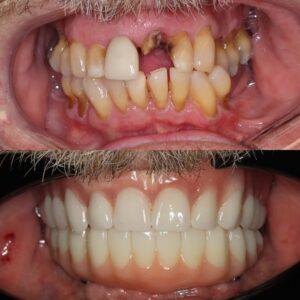
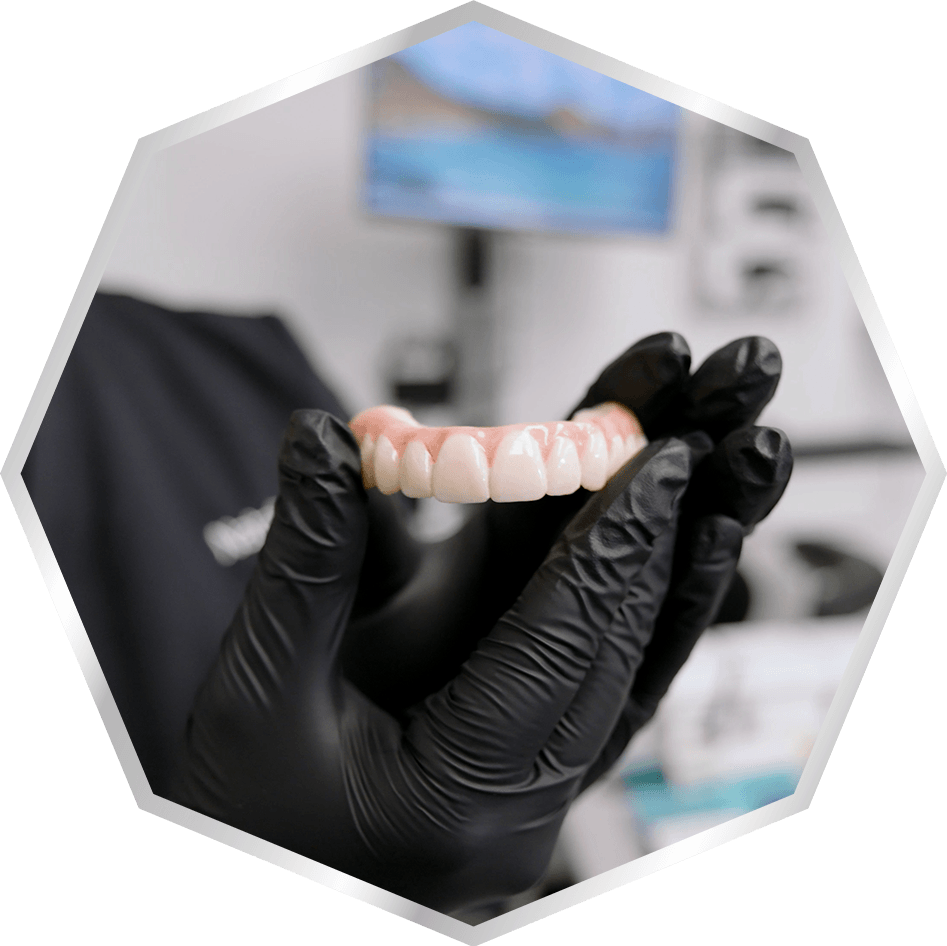
Choosing your All-on-4® teeth color and shape is one of the more personal parts of receiving a new smile. While much of dental implant treatment focuses on bone health, implant placement, and restoring your ability to chew, the appearance of your new teeth matters too.
Some patients want a bright, noticeable smile. Others prefer something subtle that closely resembles the teeth they had when they were younger. You might want to correct years of discoloration, replace severely worn teeth, or simply feel comfortable smiling in photographs again.
There is no single tooth shade or shape that looks right on everyone.
Your new teeth should complement your facial features, fit your bite, and reflect your preferences. Understanding how these decisions are made can help you feel more involved in the design process.
Why Smile Design Matters With All-on-4®
All-on-4® treatment replaces an entire arch of teeth using a fixed restoration supported by dental implants.
Unlike replacing a single missing tooth, a full arch restoration gives your dental team an opportunity to evaluate the appearance of your smile as a whole.
Tooth length, width, positioning, shade, and the way your teeth appear when you smile all contribute to the finished result.
These details also affect function. Teeth cannot simply be made longer, wider, or positioned wherever someone thinks they look attractive. Your bite, available space, facial anatomy, and implant positions must be considered.
The goal is to create a smile that looks appropriate while functioning comfortably.
How Do You Choose the Right Tooth Color?
One of the first questions patients ask is how white their new teeth can be.
The answer depends partly on personal preference.
Some people love the appearance of very bright white teeth. Others prefer a softer shade with a more natural appearance.
Your dental team may use a dental shade guide to help you compare different options.
A shade that looks beautiful on a small sample can appear quite different when applied to an entire arch of teeth. This is why it helps to consider the overall effect rather than choosing a color based only on which sample looks whitest.
Your skin tone, facial features, existing teeth, and the appearance you want to achieve can all influence the discussion.
If you are replacing only one arch, the color of your remaining natural teeth or existing restorations is another important consideration.
Do Your All-on-4® Teeth Have to Be Extremely White?
Absolutely not.
A common misconception is that receiving a full set of replacement teeth automatically means getting an extremely bright Hollywood smile.
That appearance is available as an aesthetic preference in some treatment plans, but it is not everyone’s goal.
Natural teeth have variations in shade, translucency, and surface appearance. They are not necessarily one completely uniform color.
Some patients prefer a brighter smile because they have spent years dealing with staining and discoloration. Others want a shade that looks similar to their natural teeth before they began experiencing dental problems.
Neither preference is inherently better.
What matters is communicating the result you want before your final restoration is completed.
What Determines the Shape of Your New Teeth?
Choosing your All-on-4® teeth color and shape involves more than selecting between rounded and square teeth.
Your dental team considers how the teeth relate to your lips, jaw, facial proportions, and bite.
For example, the length of your front teeth influences how much tooth structure is visible when you speak and smile.
The width and proportions of the teeth also affect the overall appearance of the smile.
Some patients prefer softer, more rounded contours. Others like a slightly stronger or more defined appearance.
Your dentist must balance these preferences with the functional requirements of the restoration.
A tooth shape that looks attractive in a photograph may not necessarily work with your individual bite.
Can You Make Your New Teeth Look Like Your Old Smile?
If you loved the appearance of your natural teeth before they became damaged or worn down, tell your dental team.
Older photographs can be useful.
You might have a picture from ten or twenty years ago where you particularly liked your smile. Even if your natural teeth are no longer in that condition, the photograph can help communicate your preferences.
Perhaps you liked the shape of your front teeth, the amount of tooth visible when you smiled, or the way your smile complemented your face.
Your dental team may not be able to recreate every detail exactly, particularly if your anatomy and treatment needs have changed.
However, photographs can provide a helpful starting point for discussing your goals.
Will Your New Teeth Look Too Big?
This is a concern worth addressing before your final teeth are made.
Patients who have lived with severely worn teeth, missing teeth, or poorly fitting dentures may initially feel that their new restoration looks unusually large.
Sometimes the difference is simply unfamiliarity.
If your natural teeth gradually became shorter over many years, seeing a full set of properly proportioned teeth again can be surprising.
However, tooth size and positioning still need to be evaluated carefully.
Your dental team considers the relationship between the teeth, lips, available restorative space, and facial proportions.
If your temporary teeth feel too prominent or you dislike their appearance, speak up.
You should not feel obligated to pretend you love a design simply because you are grateful to have new teeth.
Why Your Temporary Teeth Are Important
Many All-on-4® treatment plans involve a temporary restoration while the implants heal.
Although temporary teeth are not necessarily identical to the final restoration, this stage can provide useful information.
You have an opportunity to experience how a full arch of teeth looks and feels in everyday life.
You may notice how your smile appears in photographs, how much of your teeth show when speaking, and whether certain contours feel unfamiliar.
Your dental team can also evaluate your bite and how the restoration functions.
If there are aspects of the temporary teeth you particularly like, mention them.
The same applies to anything that concerns you.
Depending on your treatment plan, this feedback may help guide the design of your final restoration.
How Much Input Do You Have in Your Smile Design?
You should feel comfortable discussing your preferences.
This is your smile, and your dental team needs to understand what you hope to achieve.
However, customization still has clinical limitations.
The final restoration must fit the implant positions, available space, gum contours, and functional requirements of your mouth.
For example, a patient may request unusually long front teeth because they like the appearance in a photograph. Their dentist may explain why that particular design would not be appropriate for their bite or facial proportions.
The best results come from combining your aesthetic preferences with professional restorative planning.
Bring examples of smiles you like, but remain open to recommendations based on your individual anatomy.
Should You Match Your New Teeth to Your Age?
There is no rule that says a particular age requires a particular tooth shade or shape.
Some patients want their new smile to resemble the teeth they had decades ago. Others see All-on-4® treatment as an opportunity to choose a brighter appearance.
The important consideration is whether the result complements your features and feels appropriate to you.
A natural-looking restoration does not have to look dull, yellow, or worn.
Likewise, a bright smile does not automatically have to appear artificial.
Thoughtful attention to proportions, contours, and shade can make a significant difference.
What if You Are Replacing Only Your Upper or Lower Teeth?
If you are receiving All-on-4® treatment for only one arch, the appearance of the opposing teeth becomes especially important.
For example, if you are replacing your upper teeth while keeping your natural lower teeth, choosing a dramatically different shade may create a noticeable contrast.
Your dentist can discuss how the new restoration will relate to the teeth you are keeping.
The same consideration applies if you have crowns, bridges, or other existing restorations.
You do not necessarily need every tooth to be identical, but the overall appearance should be planned intentionally.
Can You Change the Color of Your All-on-4® Teeth Later?
This is an important reason to think carefully about your final shade.
Unlike natural teeth, common dental restoration materials do not respond to traditional whitening treatments in the same way.
You should not assume you can simply whiten your finished All-on-4® restoration if you later decide you want a brighter color.
Changing the shade of a completed restoration may require professional evaluation and potentially replacing restorative components, depending on its design and material.
If you are uncertain about the color, discuss your options before approving the final restoration.
It is much easier to communicate your preferences during the design process than to discover afterward that you wanted something different.
Will the Final Teeth Look Exactly Like the Temporary Teeth?
Not necessarily.
Temporary and final restorations serve different purposes and may be made using different materials and fabrication methods.
Your temporary teeth allow you to have a functional restoration during healing while your dental team monitors your progress.
Your final teeth are designed using the information gathered throughout treatment.
Depending on your individual plan, the final restoration may include refinements to its appearance, contours, bite, or other characteristics.
Ask your dental team which aspects of the temporary restoration will carry over into the final design.
If you love your temporary smile, make sure they know.
If you would like something changed, this is an important conversation to have before the final restoration is completed.
How to Prepare for Your Smile Design Appointment
You do not need to understand dental anatomy or restoration materials to communicate what you want.
Think about the appearance you hope to achieve.
Do you want a bright white smile or a softer, more natural shade? Do you prefer rounded or more defined tooth shapes? Is there something about your previous smile you would like to preserve?
Photographs can help communicate preferences that are difficult to explain with words alone.
It is also useful to identify what you do not want.
Maybe you are worried about teeth looking too large, too uniform, or noticeably artificial.
Being specific gives your dental team a better understanding of your expectations.
Remember that the design process is not about choosing teeth from a catalog. It is about creating a restoration appropriate for your mouth and your goals.
Choosing a Smile That Feels Like Yours
Your new teeth will become part of your everyday appearance.
You will see them when you look in the mirror, speak with friends, laugh at dinner, and smile for photographs.
That is why choosing your All-on-4® teeth color and shape deserves thoughtful attention.
A successful restoration should do more than replace missing teeth. It should help you feel comfortable with your smile while supporting proper function.
At Full Arch Dental Implant Center in Lake Havasu City, we believe patients should have the opportunity to discuss their aesthetic goals throughout the treatment process. Whether you want a brighter smile or something that closely resembles the teeth you once had, those preferences are an important part of planning your restoration.
Your new smile should not look like everyone else’s. It should be designed with you in mind.