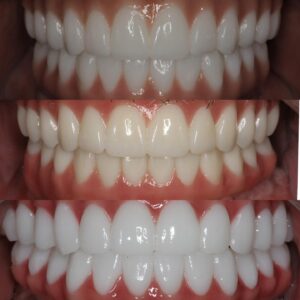
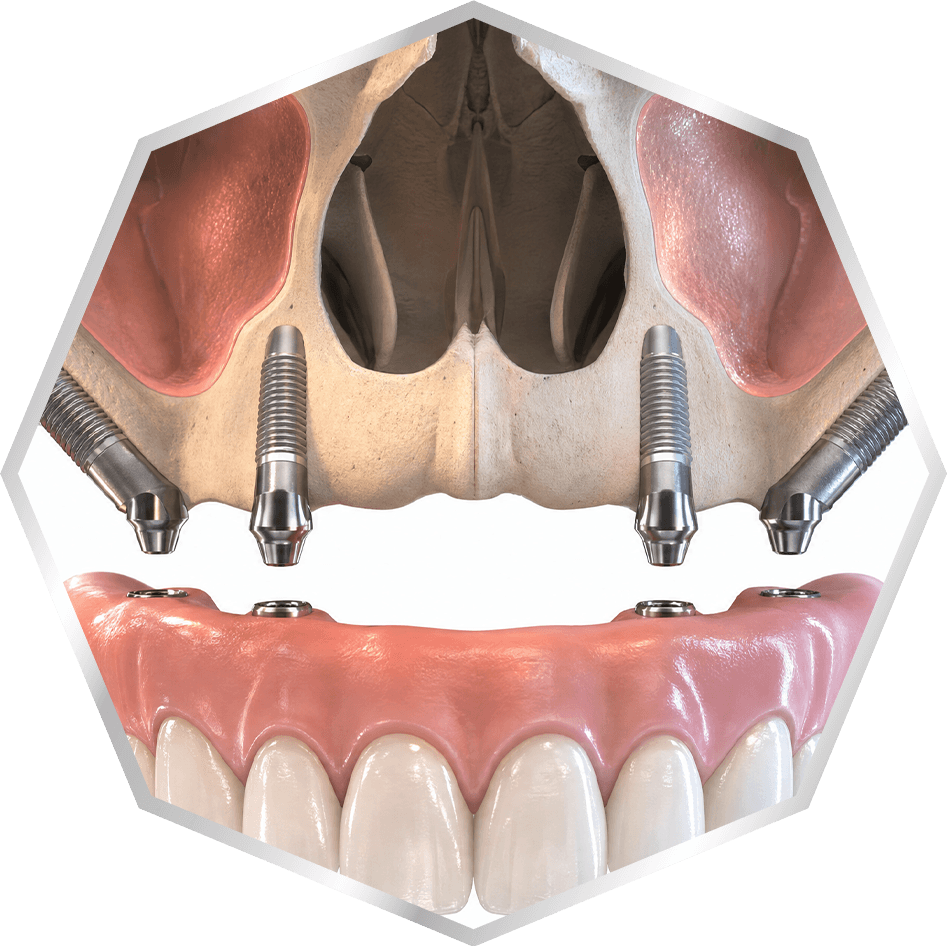
Using a water flosser with All-on-4® dental implants can become an important part of keeping your new teeth and the tissues underneath them clean. Once you have a full arch restoration, your oral hygiene routine changes. You are no longer flossing between individual natural teeth in the same way you did before treatment.
Instead, one of your biggest cleaning priorities is the space underneath your All-on-4® restoration.
Food particles, plaque, and bacteria can collect in areas that a regular toothbrush simply cannot reach. A water flosser can help flush those difficult areas and make daily maintenance easier for many patients.
However, there is an important distinction between caring for a fully healed All-on-4® restoration and cleaning your mouth immediately after implant surgery.
If you recently had surgery, do not start blasting water around your healing implants because you bought a new water flosser. Follow your dental team’s postoperative instructions and wait until they tell you it is appropriate to introduce one.
Why All-on-4® Teeth Need a Different Cleaning Routine
All-on-4® teeth are fixed in place.
You do not remove the restoration every night the way someone might remove a traditional denture.
That stability is one of the major differences patients notice, but it also means you need a reliable way to clean underneath the restoration while it remains in your mouth.
Your toothbrush handles the surfaces you can easily reach.
The harder part is underneath.
Depending on the design of your restoration and the shape of your gums, there may be small spaces where food and plaque can accumulate.
If those areas are ignored, bacteria can remain close to the gum tissue and implant sites.
That is why brushing alone may not be enough for long-term All-on-4® maintenance.
How Does a Water Flosser Work?
A water flosser uses a controlled stream of water to clean areas around teeth, gums, and dental restorations.
Instead of physically passing a strand of floss through an area, you direct the stream where you want to remove loose food and debris.
For All-on-4® patients, that can be especially useful underneath a full arch restoration.
The stream can reach areas that are difficult to access with a toothbrush.
A water flosser also gives you more control over where you clean once you understand the shape of your restoration.
The key is learning how to use it correctly.
Simply filling the reservoir, turning the machine to maximum pressure, and spraying water around your mouth is not necessarily the best technique.
Using a Water Flosser With All-on-4® Dental Implants
When using a water flosser with All-on-4® dental implants, your dental team can show you where the restoration meets your gum tissue and how to direct the water into areas that tend to collect debris.
You may need to approach the restoration from several angles.
Move slowly rather than rushing across the entire arch.
The goal is to allow the water to flush underneath the restoration rather than simply spraying the visible front surfaces of your teeth.
You will probably make a mess the first few times.
That is normal.
Lean over the sink, keep your lips partially closed around the tip, and allow the water to drain from your mouth as you work.
Once you learn the technique, the process becomes much easier.
What Pressure Setting Should You Use?
More pressure does not automatically mean better cleaning.
If you are new to a water flosser, your dental team may recommend beginning with a lower setting and increasing it if appropriate.
Your gums should not have to survive a pressure washer every night for your teeth to be clean.
The appropriate setting can depend on your particular device, your restoration, the condition of your gum tissue, and how far along you are in recovery.
If the water stream consistently causes pain or significant bleeding, do not simply turn the machine higher because you assume your gums need to “get used to it.”
Ask your dental team to evaluate what is happening.
When Can You Start Using One After Surgery?
This is one of the most important questions.
Immediately after All-on-4® surgery, your mouth is healing.
Your dental team will provide specific instructions about brushing, rinsing, and cleaning around the surgical areas during this period.
Do not introduce a water flosser before you have been cleared to use it.
The strong stream of water that is useful for cleaning a healed restoration may not be appropriate around fresh surgical sites.
Your dentist will tell you when your mouth is ready and may recommend a particular pressure setting or technique when you begin.
If you already owned a water flosser before treatment, do not assume you can continue using it exactly as you did before surgery.
Your mouth has changed.
Your cleaning routine needs to change with it.
Does a Water Flosser Replace Brushing?
No.
A water flosser and a toothbrush do different jobs.
Your toothbrush cleans the accessible surfaces of your restoration and helps remove plaque around the gumline.
The water flosser helps reach areas underneath and around the restoration that brushing may miss.
Think of them as teammates rather than competitors.
You would not stop washing the outside of a cup because you cleaned the inside.
Your All-on-4® restoration needs attention on the visible surfaces and underneath.
A complete routine may involve brushing plus a water flosser and, depending on your needs, other tools recommended by your dental team.
Does a Water Flosser Replace Regular Floss?
Not necessarily.
Your dental team may recommend specialized floss or floss threaders that allow you to clean underneath the restoration.
Some patients may use a combination of techniques.
A water flosser is convenient, but convenience should not automatically determine your entire hygiene routine.
The design of full arch restorations can vary, and your dental team can see exactly where plaque tends to accumulate in your mouth.
That allows them to recommend tools based on what you actually need rather than giving everyone the exact same routine.
If your hygienist recommends both a water flosser and specialized floss, ask them to demonstrate how each should be used.
Why Cleaning Underneath Matters So Much
Your All-on-4® replacement teeth cannot develop cavities the way natural teeth can.
That does not mean bacteria no longer matter.
Your dental implants are surrounded by living gum tissue and supported by bone.
Plaque accumulation around implants can contribute to inflammation in those tissues.
That is what you are protecting when you clean underneath your restoration.
You are not trying to prevent a cavity inside an artificial tooth.
You are trying to maintain a healthy environment around the implants supporting the entire arch.
That makes daily cleaning just as important after receiving All-on-4® as it was when you had natural teeth, even though the reasons are somewhat different.
Can a Water Flosser Help With Food Getting Stuck?
Yes, this is one of the reasons many All-on-4® patients find water flossers useful.
Small food particles can sometimes find their way underneath a full arch restoration.
Rinsing with water after a meal may remove some loose debris, but a water flosser can provide more targeted cleaning once you have been cleared to use one.
If you constantly notice food collecting in the exact same area, however, mention it to your dental team.
You may simply need to improve your cleaning angle, but your dentist should know if one area has become unusually difficult to maintain.
Do not spend months fighting with the same spot without saying anything.
What If Your Gums Bleed When You Use It?
A small amount of bleeding can have different causes, and persistent bleeding should not simply be accepted as normal.
Your technique or pressure setting may need to be adjusted.
The gum tissue may also be inflamed.
If bleeding continues despite proper cleaning, let your dental team evaluate the area.
The same applies if you notice swelling, tenderness, drainage, a persistent bad taste, or an unusual odor.
Those symptoms do not automatically mean there is a serious problem with your implants, but they deserve attention.
Your mouth should generally feel stable and comfortable once you are fully healed.
Professional Cleanings Are Still Necessary
Buying a good water flosser does not mean you can stop going to the dentist.
Home care and professional maintenance serve different purposes.
During a maintenance visit, your dental team can evaluate your implants, gums, bite, and restoration. They can also identify areas of buildup that you may be consistently missing at home.
This is actually a great opportunity to improve your water flosser technique.
Ask where they are seeing buildup.
If one area repeatedly needs extra professional cleaning, have your hygienist show you how to target it more effectively at home.
Your maintenance appointments should help make your daily routine better.
Make It Part of Your Normal Routine
The best oral hygiene tool is the one you actually use consistently.
If your water flosser lives in a cabinet because setting it up feels like too much work, it is not doing much for your implants.
Keep it somewhere convenient.
Build it into the same part of your morning or evening routine each day.
At first, cleaning underneath an entire restoration may feel like another chore added to your life.
Eventually, it should become ordinary.
You brush.
You clean underneath your restoration.
You move on with your day.
That consistency is far more useful than an elaborate cleaning session once every couple of weeks.
Can You Use a Water Flosser With All-on-4® Dental Implants?
A water flosser with All-on-4® dental implants can be a useful tool for removing food and debris from underneath a full arch restoration, especially in areas a toothbrush cannot easily reach.
It should not automatically replace brushing or every other cleaning method your dental team recommends, and it should not be used around fresh surgical areas until you have been cleared to do so.
At Full Arch Dental Implant Center in Lake Havasu City, we want patients to understand how to care for their new teeth long after surgery is finished. All-on-4® treatment gives you a new smile, but protecting the gums and bone supporting that smile requires consistent maintenance. Learning how to properly use tools like a water flosser can make that daily care much easier.
What Happens if You Skip All-on-4® Maintenance Appointments?
All-on-4® maintenance appointments can be easy to underestimate once your new teeth feel comfortable and everything seems to be working