A soft food diet after All-on-4® surgery can seem strange when your new teeth already feel solid. You may leave treatment with a fixed set of teeth, look in the mirror, carefully bite down, and think everything feels surprisingly strong. If the teeth are attached to dental implants, why are you being told to eat eggs, pasta, fish, mashed potatoes, and other soft foods instead of biting into a steak?
The answer has less to do with the strength of the teeth you can see and more to do with what is happening underneath them.
Your dental implants have just been placed into your jawbone. Although the restoration may be fixed in place, the biological healing process surrounding those implants has only begun.
That early healing period is exactly why your diet matters.
Your New Teeth and Your Implants Are Not the Same Thing
One of the easiest ways to understand All-on-4® recovery is to separate the visible teeth from the implants underneath them.
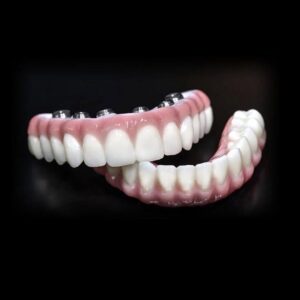
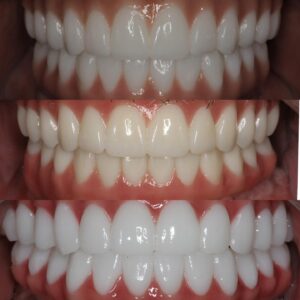
The restoration is the part you see when you smile.
The dental implants are positioned in the jawbone and support that restoration.
Immediately after surgery, your restoration may feel stable because it is securely attached. That does not mean the bone surrounding each implant has finished healing.
The implants need time to become biologically integrated with the surrounding bone.
This process is known as osseointegration.
It does not happen overnight.
Your implants can therefore feel strong long before they have completed the healing process that provides their long-term biological stability.
What Is Osseointegration?
Osseointegration is one of the most important concepts in dental implant treatment.
After an implant is placed, the surrounding bone heals around its surface. Over time, this creates the stable relationship between implant and bone that allows dental implants to function as long-term tooth replacements.
This process generally takes months rather than days.
During that time, your dentist wants to control how much force is being placed on the implants.
Your restoration may allow you to use your teeth during recovery, but that does not mean you should immediately test them with the hardest foods you can find.
Think of the early restoration as functional but still under protection.
Why a Soft Food Diet After All-on-4® Surgery Matters
The soft food diet after All-on-4® surgery helps limit excessive chewing forces during the period when the implants are healing.
Chewing creates pressure.
Harder and tougher foods generally require more force to break down.
A soft piece of fish does not challenge your new implants the same way biting through a hard piece of candy or repeatedly chewing tough steak might.
That difference matters during early healing.
Your dentist is not necessarily worried that your visible teeth will instantly fall apart if you chew something firm.
The larger concern is protecting the implants and the healing tissues underneath them from unnecessary stress.
Why Do the Teeth Feel So Strong Already?
Because the restoration is fixed.
That is one of the major differences between All-on-4® and a removable denture.
Patients can sometimes mistake that immediate stability for complete healing.
If you press your tongue against the restoration and it does not move, it is understandable to think, “These are solid. I can eat normally.”
But what your tongue can feel is not the same thing your dentist is evaluating.
The biological relationship between your implants and jawbone cannot be judged by how strong the restoration feels when you gently bite down.
This is why postoperative instructions should determine your diet, not how confident you feel on a particular day.
What Foods Are Usually Easier During Recovery?
Your dental team should give you specific dietary instructions, but the general idea is to choose foods that require minimal chewing effort.
Eggs, yogurt, cottage cheese, oatmeal, mashed potatoes, soft pasta, flaky fish, well-cooked vegetables, beans, soups, smoothies eaten according to postoperative instructions, and appropriately prepared soft proteins can all be easier options.
Protein is especially useful during recovery because your body needs nutrients while healing.
Soft does not have to mean living on pudding for weeks.
You can still create meals with protein, vegetables, carbohydrates, and other nutrients while keeping the texture appropriate for your recovery.
The important question is not just, “Can my teeth break this food?”
Ask, “How much chewing force will this require?”
What Foods Can Put More Pressure on Healing Implants?
Foods that are hard, crunchy, sticky, or extremely chewy can require considerably more force.
Nuts, popcorn kernels, hard candy, tough meat, crunchy chips, hard crusts, ice, and similar foods may not fit your early postoperative diet.
Even foods that seem healthy can be surprisingly demanding.
A raw carrot is healthy.
That does not automatically make it appropriate shortly after implant surgery.
The same goes for apples.
Eventually, you may be able to enjoy many of these foods again, but early recovery is about protecting healing rather than proving how powerful your new bite is.
What Happens if You Accidentally Eat Something Too Hard?
Do not panic.
Accidentally chewing something firmer than intended does not automatically mean you damaged your implants.
Stop eating the food and return to the diet recommended by your dental team.
Pay attention to how your mouth feels.
If you notice a sudden change in your bite, unusual pain, movement of the restoration, a cracking sensation, significant bleeding, or anything else that concerns you, contact your dental office.
Do not repeatedly bite down to “test” whether everything is still secure.
If you think something changed, let your dentist evaluate it.
Can Chewing Too Hard Cause an Implant to Fail?
Dental implant healing involves several factors, and you cannot attribute every implant complication to a single bite of food.
However, controlling excessive forces during early healing is important.
That is one reason dentists provide dietary restrictions in the first place.
The implants are being asked to heal while also supporting a restoration.
Your dentist designs your treatment to manage those forces appropriately.
Your job is to avoid unnecessarily increasing them by ignoring your dietary instructions.
This is particularly important when you begin feeling better.
The period when soreness disappears can actually make patients more tempted to push their diet too quickly.
Feeling Better Does Not Mean You Are Finished Healing
This may be the most important thing to remember about All-on-4® recovery.
Your comfort can improve much faster than your bone heals.
After the initial swelling and tenderness begin to disappear, you may feel almost normal.
That is great.
But your implants do not suddenly skip the remainder of the healing process because your mouth stopped hurting.
Continue following your dietary restrictions for as long as your dentist recommends.
Do not shorten the timeline yourself because recovery has been easier than expected.
What About Chewing on the Other Side?
With a single dental implant, a patient may sometimes think about chewing away from a particular surgical site.
All-on-4® is different because an entire arch is being supported by implants.
The forces generated during chewing can be distributed through the restoration.
Trying to choose one “safe side” does not necessarily give you permission to eat foods outside your recommended diet.
Follow the overall diet your dentist provides rather than trying to develop your own workaround.
Your Temporary Teeth Need Protection Too
Another reason to be careful is the restoration itself.
Depending on your treatment plan, the teeth you receive around the time of surgery may be a temporary restoration designed for the healing period.
Temporary does not mean flimsy.
It means the restoration serves a particular purpose during this stage of treatment.
You still need to protect it.
Hard or inappropriate foods can potentially damage dental restorations.
If a temporary tooth chips or the restoration feels different, contact your dental team rather than attempting to repair it yourself.
When Can You Start Eating Normally Again?
This depends on your individual healing progress.
Your dental team will monitor you during follow-up appointments and let you know when your diet can expand.
Do not use someone else’s timeline.
One person online may say they ate a hamburger after a certain number of days. Another may claim they returned to steak almost immediately.
Neither person knows what happened during your surgery.
Your implant stability, bone quality, additional procedures, health history, restoration, and healing progress are specific to you.
Your dentist’s instructions should always win over a social media comment.
Will You Always Have Food Restrictions With All-on-4®?
The early soft diet is not intended to become your permanent way of eating.
One of the major goals of full arch implant treatment is to restore useful chewing function.
After healing, patients are generally able to enjoy a much broader diet than they could during the postoperative period.
However, having strong replacement teeth does not mean treating them as indestructible tools.
Even natural teeth can crack when people chew ice, hard candy, or other extremely hard objects.
Dental restorations can also wear, chip, or become damaged.
Long-term common sense still matters.
Your dentist can explain whether there are any particular foods or habits you should avoid with your final restoration.
The Soft Diet Has an End Goal
Nobody gets excited about spending weeks thinking about the texture of everything on their plate.
But there is a reason for it.
You are protecting the foundation underneath your new teeth during one of the most important stages of treatment.
A few weeks or months of being careful can feel frustrating when your teeth already seem capable of doing more.
Try to look at the bigger picture.
You did not go through full arch implant treatment simply to have strong teeth for the first month.
The goal is to create a smile you can depend on for years.
Giving the implants appropriate time to heal is part of reaching that goal.
Why Do All-on-4® Patients Need a Soft Food Diet?
A soft food diet after All-on-4® surgery protects dental implants while the surrounding bone and tissues heal. Your new teeth may feel stable almost immediately, but the implants underneath them are still going through osseointegration.
That is why the way your teeth feel should not determine what you eat.
Follow the diet and timeline provided by your dental team, even when your mouth starts feeling completely normal.
At Full Arch Dental Implant Center in Lake Havasu City, we want patients to understand the reason behind their postoperative instructions rather than simply being handed a list of rules. Your soft food diet is temporary, but the healing it helps protect plays an important role in building the long-term foundation for your All-on-4® smile.